AI Follow-Up Emails vs. Manual Sequences: Key Differences

AI follow-up emails and manual sequences each have their strengths, but choosing the right approach depends on your goals. AI excels in high-volume outreach with automated, data-driven personalization and 24/7 availability, delivering reply rates of up to 85% and lowering customer acquisition costs (as low as $2.86). Manual sequences, on the other hand, are better suited for high-value deals requiring a personal touch, empathy, and tailored communication.
Key Takeaways:
- AI Follow-Ups: Automated, scalable, cost-effective, works around the clock, ideal for large campaigns.
- Manual Sequences: Time-intensive, higher cost, but effective for complex, high-stakes deals.
- Hybrid Approach: Combines AI efficiency with human expertise for balanced results.
Quick Comparison:
| Metric | AI Follow-Ups | Manual Sequences |
|---|---|---|
| Lead Volume Capacity | Thousands simultaneously | Limited by human hours |
| Cost Per Lead | Low (e.g., $2.86 CAC) | High (labor-intensive) |
| Reply Rate | Up to 85% | Lower, less consistent |
| Best Use Case | High-volume campaigns | High-value opportunities |
AI suits businesses needing scalability and efficiency, while manual efforts shine in personalized, relationship-driven scenarios. A hybrid strategy often delivers the best results by leveraging the strengths of both.
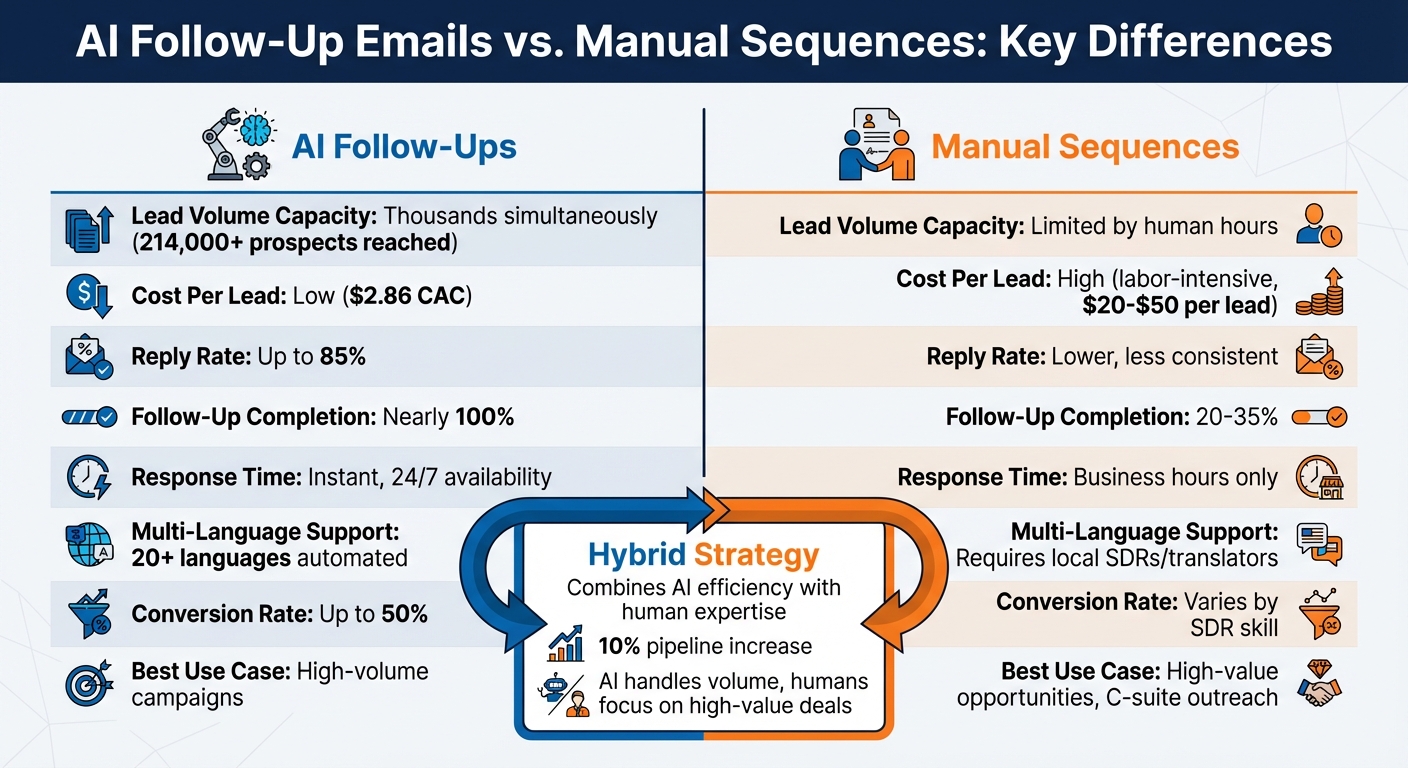
AI vs Manual Email Follow-Up Sequences: Performance Metrics Comparison
Efficiency and Scalability: AI vs. Manual Sequences
AI: Automating at Scale
AI-powered platforms can manage outreach on a scale that human teams simply can't match. For instance, Salesforge enables teams to handle thousands of leads simultaneously, eliminating seat-based restrictions by offering unlimited mailboxes and LinkedIn senders. Its AI SDR, Agent Frank, takes care of the entire sales process - from prospecting and crafting personalized messages to following up and booking meetings - without needing human input.
Take the example of AKOOL in 2024: they reached over 214,000 prospects using AI-driven tools, achieving a positive reply rate of more than 16%. Similarly, UniteSync, under CEO Carlos Palop, automated tasks like domain setup, inbox warming, and managing daily sending limits. This allowed them to onboard 4 to 5 new creators daily with an impressive 85.26% positive reply rate, all while keeping their Customer Acquisition Cost at just $2.86. As Carlos Palop explained:
"Tying your strategy of setting up domains + inboxes + warming up + daily limits with our royalty audit lead magnet has allowed us to grow efficiently, bringing in strong results without excessive effort."
AI systems work around the clock, offering instant responses and managing multi-channel outreach - across email and LinkedIn - in over 20 languages at the same time. Centralized dashboards consolidate replies, ensuring no lead is overlooked. AI email tools can cut email drafting time by half, and executives report saving about 4 hours weekly on inbox management. These time and efficiency gains allow AI systems to deliver unmatched scalability and consistency compared to manual processes.
Manual Processes: Time-Consuming and Limited
On the other hand, manual processes face clear limitations. SDRs are bound by their working hours, personal capacity, and the inherent challenges of scaling outreach. Tasks like prospect enrichment, intent identification, mailbox setup, sequence creation, and reply tracking all require significant manual effort, creating bottlenecks along the way.
Follow-up rates, in particular, suffer in manual workflows. While automated systems ensure nearly 100% execution of planned touches, manual efforts typically achieve only 20–35%. Reps may miss reminders, overlook leads, or struggle to maintain consistent follow-ups as their workload grows. Manual systems also operate only during business hours, leaving nights, weekends, and other time zones uncovered - leading to missed opportunities and inconsistent outreach.
Comparison Table: Efficiency Metrics
| Metric | AI-Driven Follow-Ups | Manual Sequences |
|---|---|---|
| Lead Volume Capacity | Thousands handled concurrently; AKOOL reached 214,000+ prospects | Limited by rep hours and attention span |
| Follow-Up Completion Rate | Nearly 100% of planned touches executed | 20–35% of planned follow-ups completed |
| Response Time | Instant, 24/7 availability | Limited to business hours only |
| Time Savings | Cuts email drafting time by up to 50%; ~4 hours saved weekly on inbox management | Entirely manual effort |
| Multi-Language Support | Automated outreach in over 20 languages | Requires hiring local SDRs or translators |
| Infrastructure Setup | Automated domain/mailbox setup and warm-up | Manual configuration for each mailbox |
The difference in efficiency is striking. AI-driven systems allow smaller teams to handle tasks that would otherwise require a much larger sales force. With 24/7 availability, automated follow-ups, and support for multiple languages, AI tools clearly outpace manual efforts, ensuring a stronger pipeline and more consistent results with far less effort.
Cost and ROI: Comparing Financial Impacts
When it comes to cost and return on investment (ROI), AI and manual outreach stand apart in how they influence efficiency and financial outcomes.
AI: Lower Costs per Lead
AI-powered outreach significantly reduces costs. Instead of staffing a team of sales development representatives (SDRs), businesses can leverage AI tools to handle tasks like prospecting, personalization, and follow-ups automatically. For example, UniteSync achieved an impressive customer acquisition cost (CAC) of just $2.86 using Salesforge's AI platform. As Carlos Palop, CEO of UniteSync, noted:
"Our CAC is currently $2.86, and we expect it to decrease even further."
Salesforge's pricing model eliminates seat-based fees, offering unlimited mailboxes and LinkedIn senders, which makes scaling outreach far more affordable. AI also removes the need for hiring translators or local SDRs for global campaigns by generating messages in over 20 languages automatically. With email automation delivering conversion rates as high as 50% and AI-personalized emails increasing reply rates by up to 300%, these tools provide a direct path to lower costs per lead and quicker pipeline growth.
Manual: Higher Costs, But a Personal Touch for High-Value Deals
Manual outreach comes with higher costs due to the labor-intensive nature of the process. Each SDR can only handle a limited number of prospects, and scaling requires hiring more staff, which adds expenses for training, salaries, and benefits. However, manual methods excel in situations where complex, high-value deals demand tailored messaging, precise timing, and a personal connection. While these approaches are costlier, they shine in scenarios that require a human touch, even if they result in fewer follow-ups and slower scalability.
Comparison Table: Cost and ROI
| Metric | AI-Driven Follow-Ups | Manual Sequences |
|---|---|---|
| Cost per Lead | Low and predictable; UniteSync achieved a CAC of $2.86 | High; includes salaries, training, and benefits |
| Pricing Structure | Unlimited mailboxes/senders; no seat-based fees | Seat-based pricing rises with team size |
| Time Investment | Minimal, reducing personnel costs | High; requires manual effort for each prospect |
| Scalability Cost | Scales without proportional cost increases | Requires hiring more SDRs to grow |
| Conversion Rates | Up to 50% with automation; 300% higher reply rates | Varies by SDR skill; lower volume overall |
| Best For | High-volume outreach and consistent pipeline growth | Complex, high-value enterprise deals |
AI tools deliver strong ROI through scalable and efficient outreach. Automation has been shown to boost conversion rates by up to 50% and contribute an additional 10% to pipeline growth. While AI is ideal for companies focused on high-volume, cost-effective strategies, manual outreach remains valuable for securing large, high-stakes deals that require a more personalized approach, even if it comes with higher costs and lower scalability.
Personalization and Reply Quality: Human Touch vs. AI Precision
When it comes to outreach, personalization plays a critical role in setting AI apart from manual efforts. While AI thrives on data and scale, human-crafted messages bring emotional depth and adaptability to the table.
AI Personalization: Data-Driven Precision at Scale
AI tools excel at analyzing data like job titles, industries, and engagement patterns to craft personalized emails - at a scale that's nearly impossible for human teams to achieve. For example, Salesforge's AI SDR, Agent Frank, is trained using proprietary data and modeled after the top 1% of sales reps. This ensures the outreach feels natural, even when it's automated, and the platform can even generate messages in multiple languages.
The numbers back up this approach. AI-personalized emails can boost reply rates by as much as 300%. Businesses using email automation report conversion rates that soar to 50%. A standout case is ChannelCrawler, which achieved an 85.71% positive reply rate by combining AI-powered outreach with automated inbox management.
Manual Personalization: Empathy and Adaptability
On the flip side, human-crafted emails shine in scenarios where empathy and nuanced communication are essential. SDRs can tailor their messages to address specific concerns and adjust their tone based on subtle cues, making this approach especially effective for high-value deals and outreach to C-suite executives. In these cases, even a small misstep could jeopardize months of effort, so the personal touch becomes invaluable.
While manual follow-ups can be inconsistent and harder to scale, they allow for direct control over brand voice and a deeper understanding of recipient-specific needs. For busy executives, a well-thought-out message that demonstrates genuine understanding can cut through the clutter in ways that generic AI templates might struggle to achieve. This human element is what makes manual outreach so impactful in building trust and relationships.
Balancing Scale and Personalization
A hybrid strategy offers the best of both worlds by combining AI efficiency with human insight. Platforms like Salesforge enable teams to run campaigns that are AI-driven, human-led, or a mix of both. In this model, AI takes care of high-volume outreach and follow-ups across channels like email and LinkedIn, while human sales reps focus on engaging prospects and closing deals. Tools such as Primebox™ further bridge the gap by using AI analysis to help sales teams respond to replies quickly and effectively.
This division of labor allows AI to handle repetitive tasks, like maintaining consistent touchpoints, freeing up human experts to concentrate on relationship-building and strategic conversations. It’s a balance that ensures both precision and personalization are working together to drive results.
Performance Metrics: Real-World Results
AI Performance: Higher Volume, Consistent Results
AI-driven follow-up sequences bring unmatched scalability and reliability. These systems can significantly enhance reply rates - by up to 300% - through personalized, data-driven emails, while achieving conversion rates as high as 50%.
Platforms like Salesforge demonstrate the power of AI in outreach, allowing businesses to connect with hundreds of thousands of prospects. Reply rates range from 16% to 85.71%, with Customer Acquisition Costs (CAC) dropping to as low as $2.86.
"Outreach at our scale requires speed, segmentation, and precision - Salesforge gave us the infrastructure to do it all at once." - AKOOL Team
AI also guarantees flawless follow-up execution. Automated reminders ensure 100% accuracy in timing, eliminating missed opportunities. This precision directly impacts growth, with companies reporting a 10% pipeline increase when leveraging AI. Hybrid approaches, which combine AI for outreach volume with human expertise for closing, further amplify bookings.
While AI leads in consistency and scale, it’s important to note that its strength lies in high-volume campaigns rather than niche, high-value conversions.
Manual Performance: Quality Over Quantity
Manual follow-up sequences prioritize precision and personalization, making them ideal for high-stakes deals. Sales teams often focus on enterprise accounts or C-suite executives, where tailored messaging and trust-building are essential. This approach thrives in scenarios where the potential deal size justifies the extra time and effort.
However, the trade-off is clear: manual sequences are labor-intensive, limiting the number of leads a team can handle and driving up costs. Despite these challenges, for deals worth six or seven figures, the human touch can be the decisive factor that seals the deal.
Comparison Table: Key Performance Outcomes
Here’s a breakdown of how AI and manual approaches stack up:
| Metric | AI Follow-Up Sequences | Manual Sequences |
|---|---|---|
| Reply Rate | 16% to 85.71% | Lower due to inconsistent follow-ups |
| Volume Capacity | 214,000+ prospects | Limited by human hours |
| Cost Per Acquisition | As low as $2.86 | Higher due to labor costs |
| Follow-Up Consistency | 100% automated timing | 20-35% accuracy |
| Pipeline Impact | 10% increase with hybrid approach | Quality-focused, smaller pipeline |
| Best Use Case | High-volume outreach, consistent touchpoints | High-value deals, executive outreach |
This comparison highlights the strengths of both approaches, helping businesses choose the right strategy based on their goals and target audience.
Choosing the Right Approach: AI, Manual, or Hybrid
When AI Makes Sense
AI-driven follow-ups are perfect for repetitive sales processes targeting prospects with similar challenges and needs. For B2B campaigns with extensive lead lists, AI offers speed and consistency that manual efforts simply can't match. Plus, it's cost-effective - AI cold emailing typically runs between $5–$15 per lead, compared to $20–$50 for manual outreach due to sales development representative (SDR) labor costs.
AI also shines in scenarios requiring instant responses and 24/7 availability. For example, automated sequences are ideal for managing inbound demo requests or free-trial signups, ensuring no potential customer slips through the cracks. Platforms like Salesforge have proven to deliver low customer acquisition costs (CAC) with efficient outreach. For early-stage or resource-constrained teams, AI-heavy workflows can help build a strong pipeline without the need to expand the team.
However, when personalized engagement is critical, manual follow-ups take the lead.
When Manual Sequences Are Better
Manual follow-ups are your best bet for high-stakes interactions where personalization and relationship-building matter. These sequences are particularly effective when the deal size justifies the extra effort. For enterprise sales, outreach to C-suite executives, or complex, high-value deals, the human touch often makes the difference. If you're negotiating six- or seven-figure contracts, the nuanced understanding and empathy that humans bring to the table are invaluable.
That said, manual processes come with trade-offs. They require significant time, are limited by working hours, and can be inconsistent. But when a single deal can bring in hundreds of thousands of dollars, the investment in a manual approach is well worth it.
Hybrid Approaches for Best Results
Many teams are now adopting a hybrid approach to combine the strengths of both AI and manual methods. For example, AI can draft personalized messages using CRM data and call notes, while sales reps review and fine-tune them before hitting send. This approach maintains the human touch while cutting email preparation time by up to 50%. It’s a way to balance AI's efficiency with the personalization needed to drive both high-volume leads and high-quality deals.
"Outreach at our scale requires speed, segmentation, and precision - Salesforge gave us the infrastructure to do it all at once." - AKOOL Team
A great example of this hybrid strategy in action is VAI Consulting, which used Agent Frank to handle initial outreach. The result? Three sales calls booked in a single week. The secret lies in letting AI handle the heavy lifting of volume and consistency, while humans focus on high-impact interactions that demand strategic thinking and relationship-building.
Conclusion
Choosing between AI and manual follow-up sequences isn’t about declaring one superior - it’s about knowing when each approach fits best. AI stands out for its scalability, consistency, and around-the-clock availability, making it an excellent choice for high-volume outreach where speed is critical. On the other hand, manual sequences excel in situations requiring a personal touch, empathy, and relationship-building, especially when the stakes are higher. For most sales teams in the U.S., a hybrid strategy strikes the perfect balance. AI can manage the repetitive, time-consuming tasks, while human reps focus on high-value, strategic interactions.
When refining your outbound strategy, think about factors like lead volume, sales cycle length, and team capacity. If your team struggles to follow up consistently or connect with every lead multiple times, AI can step in to handle the cadence. However, for deals involving senior executives or significant revenue, manual outreach remains indispensable. Teams that integrate AI-assisted follow-ups often report a 10% or more increase in pipeline contribution, while also enabling reps to reach far more prospects without driving up costs.
Salesforge’s platform highlights the potential of AI-driven outreach. With features like unlimited mailboxes, automated warm-ups, and end-to-end AI SDR execution, it enables campaigns to achieve impressive reply rates and maintain low customer acquisition costs (CAC). These results show how leveraging data can reshape and elevate your outreach efforts.
To optimize your process, start by auditing your sequences to identify areas for improvement. Test AI with high-volume, lower-priority leads, while reserving manual touches for enterprise-level opportunities. Tools like Warmforge and email validation can safeguard your domain reputation as you scale. Keep an eye on metrics like reply rates, meetings booked, and cost per opportunity, and let the data guide you in gradually increasing AI’s involvement.
FAQs
How does AI-driven email personalization impact reply rates compared to manual efforts?
AI-powered email personalization consistently delivers better reply rates compared to manual methods. On average, tools driven by AI can achieve positive reply rates of 16% or more, while manual approaches often fall short in terms of engagement.
This advantage comes from AI's ability to customize messages on a large scale, making each email feel relevant and tailored to the recipient - all without the need for time-consuming manual work. Platforms like Salesforge enable businesses to simplify their outreach process while significantly improving response rates.
How does the cost of using AI-driven follow-up emails compare to manual sequences?
AI-powered follow-up emails, using tools like Salesforge, can save money in the long run thanks to automation, scalability, and reduced manual workload. While the initial setup or subscription fees might seem steep, the ability to personalize messages at scale and save valuable time often makes up for those costs.
On the other hand, manual email sequences may start with lower upfront costs but demand a lot of time and effort to maintain. As your outreach volume increases, these methods can become more expensive and harder to manage effectively.
When is it better to combine AI-driven tools with manual email strategies?
A hybrid approach shines when you need to strike a balance between efficiency and personalization, all while keeping human oversight in the mix. AI tools, like those from Salesforge, are fantastic for automating repetitive tasks like prospecting, follow-ups, and scaling outreach efforts. But here’s the key: manual input plays a crucial role in ensuring your messages feel tailored and relevant, especially when dealing with high-value prospects or navigating complex negotiations.
By blending the speed and scalability of AI with the precision and thoughtfulness of human input, you can boost engagement, foster stronger connections, and adjust strategies to handle more nuanced situations. This method works particularly well for teams managing varied sales pipelines or juggling a mix of high-priority leads and larger, volume-based opportunities.
.png)

.png)